The truth about wills, trusts, probate, beneficiaries, transfer-on-death deeds, and inheritance taxes
Estimated reading time: 15 -17 mins
People often hear that they need a trust or their children will not be able to receive their house, bank accounts, or other property after they die. That statement contains a little truth, but it leaves out a lot of important information.
Your children do not automatically receive immediate control over everything simply because they are your children. However, that does not mean everyone needs an expensive trust.
What happens to your property depends on:
- What you own.
- How each asset is legally titled.
- Whether a beneficiary is listed.
- Whether that beneficiary is an adult or a minor.
- Whether the property was transferred into a trust.
- Whether debts, liens, or family disputes exist.
- The laws of the state involved.
The real goal is not simply to say who should receive your property. The goal is to give every important asset a clear and legally valid path to the correct person.
Important state-law notice: Estate and probate laws are not identical in every state. This article explains general principles that apply throughout much of the United States and uses Georgia examples where specifically identified. Your state may have different rules concerning wills, trusts, transfer-on-death deeds, probate, surviving spouses, minor beneficiaries, creditors, taxes, and Medicaid estate recovery. Verify your state’s requirements through its official court, legislature, or revenue-department website, or consult an estate-planning attorney licensed in your state.
The First Question: How Is the Property Set Up?
When someone dies, every asset does not necessarily follow the same path.
A will controls certain probate assets, while beneficiary forms, survivorship language, trusts, and transfer-on-death arrangements may control other assets.
Here are four common ways property can transfer:
- Beneficiary designation: Life insurance, retirement accounts, and certain bank or investment accounts can name someone to receive the money after the owner’s death. These assets usually pass outside probate when the beneficiary designation is valid.
- Joint ownership with survivorship rights: Some jointly owned property automatically passes to the surviving owner. Merely seeing two names on an account or deed is not enough. The legal form of ownership and exact wording matter.
- A properly funded trust: Property legally transferred into a trust is controlled by the trust’s instructions. It generally does not pass through ordinary probate.
- A will or state inheritance law: Property owned only in the deceased person’s name, without a beneficiary or other automatic transfer method, normally becomes part of the probate estate.
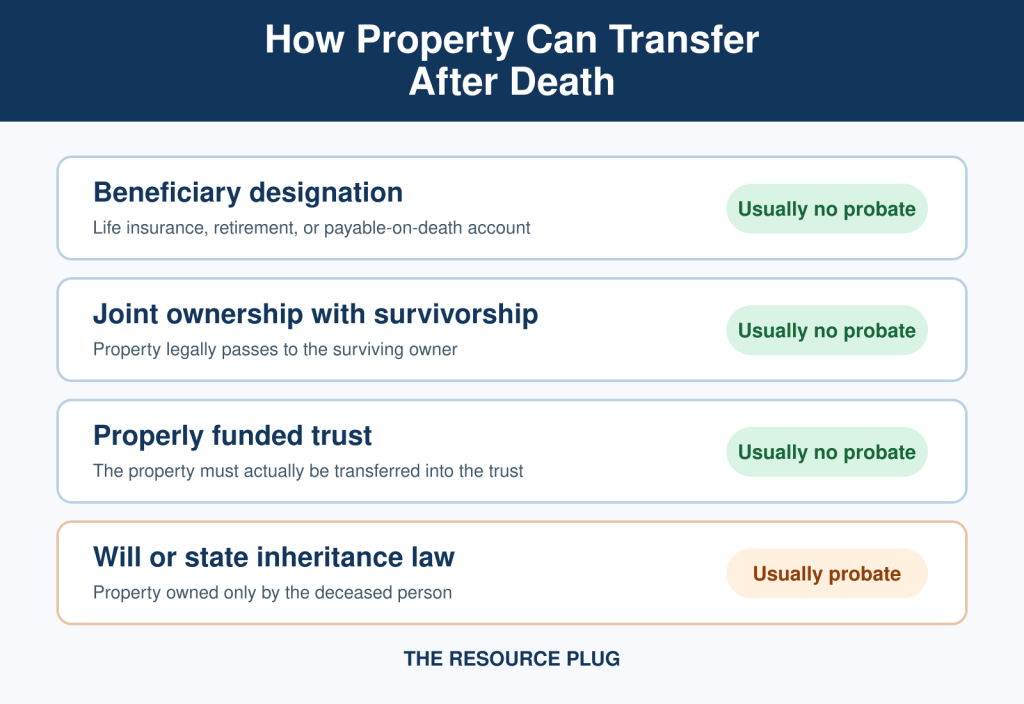
Four common ways property may transfer after death. Exact results depend on the account terms, deed language, type of ownership, and applicable state law.
What Happens When Someone Dies Without a Will?
Dying without a valid will is called dying intestate.
That does not mean the state automatically takes everything. Each state has an intestate-succession law identifying which relatives inherit when someone dies without a will.
Depending on the family, the legal heirs may include:
- A surviving spouse.
- Children.
- Parents.
- Siblings.
- More distant relatives.
The result may be very different from what the deceased person would have chosen.
Even when the children are clearly the legal heirs, they may still need court authority before they can sell, refinance, or transfer property that remained solely in the deceased parent’s name.
Debts, liens, taxes, mortgages, and the legal rights of every heir may also need to be addressed.
Example: A House With No Will
Denise owns a house in her name alone. She has three adult children but no will, trust, or transfer-on-death deed.
After Denise dies, her children may be her legal heirs under state law, but they cannot necessarily walk into the courthouse and immediately place the house in their names.
The family may need a probate proceeding so that someone has legal authority to handle the estate and establish clear ownership of the house.
Georgia example: Georgia may allow formal estate administration or, in qualifying cases, a simplified procedure called a Petition for No Administration Necessary. The correct option depends on the heirs, debts, creditors, and other circumstances.
Learn more from Georgia Legal Aid:
https://www.georgialegalaid.org/resource/what-should-i-know-about-the-probate-process-in-georgia
What Does a Will Actually Do?
A will can:
- Identify who should receive property that passes through the estate.
- Nominate the person who should administer the estate.
- Nominate guardians for minor children.
- Provide instructions for personal belongings and other probate property.
A will does not ordinarily avoid probate.
The will is generally filed with the probate court so it can be legally accepted and the executor can receive authority to act.
A will also does not usually override a valid beneficiary designation.
Example: The Will and Beneficiary Form Disagree
Denise’s will says that she wants everything to go to her daughter. However, Denise’s life-insurance policy still names her former partner as the beneficiary.
The insurance company will generally follow the valid beneficiary form, not the will, unless there is a legal reason to challenge the designation.
That is why estate planning must include more than writing a will. Beneficiary forms should be reviewed after:
- Marriage.
- Divorce.
- The birth of a child.
- The death of a beneficiary.
- A major change in family relationships.
- A significant financial change.
When a Beneficiary Designation Makes Things Easier
Accounts and contracts that commonly permit beneficiaries include:
- Life-insurance policies.
- Traditional and Roth IRAs.
- Workplace retirement accounts such as 401(k)s.
- Payable-on-death bank accounts.
- Transfer-on-death investment accounts.
- Certain annuities and other financial contracts.
When an adult is properly named as beneficiary, that person can generally submit a certified death certificate, identification, and the company’s claim paperwork.
The asset normally does not need to pass through probate first.
However, the beneficiary cannot simply continue using the deceased person’s debit card, checks, password, or online banking account. The financial institution must verify the death and properly process the claim.
Example: An Adult Beneficiary
Marcus names his 25-year-old son as the payable-on-death beneficiary of a bank account.
After Marcus dies, his son contacts the bank and completes its claim process. Assuming the beneficiary designation is valid, the account generally passes directly to him instead of going through probate.
When Beneficiary Designations Cause Problems
Problems can arise when:
- No beneficiary was named.
- The designation was never properly completed.
- The financial institution never accepted or recorded the designation.
- The named beneficiary died before the account owner.
- No backup beneficiary was named.
- An ex-spouse or estranged relative remains listed.
- Names or identifying information do not match.
- The owner’s estate was named as beneficiary.
- Family members claim the form was changed through fraud or pressure.
- The account owner lacked the mental capacity to make the change.
- A minor child was named directly.
This is why people should name both primary and backup beneficiaries and review the information regularly.
Minor Children Cannot Directly Control an Inheritance
A child can be named as a beneficiary, but a financial institution generally cannot hand substantial money or property directly to a minor.
The child’s parent also does not automatically receive unrestricted authority over the inheritance simply because they are the parent.
Depending on state law and the asset involved, the family may need:
- A court-supervised conservatorship.
- A custodial account established under state law.
- A trust.
- Another legally authorized arrangement.
A guardian generally makes personal-care decisions for a child, while a conservator manages the child’s property. The exact terminology and requirements vary by state.
Example: A Minor Receives Life Insurance
Marcus directly names his seven-year-old daughter as the beneficiary of a $100,000 life-insurance policy.
After Marcus dies, the insurance company cannot simply deposit $100,000 into a seven-year-old’s checking account. It also may not be able to hand the entire amount directly to her mother.
Depending on the policy and state law, a conservator or another legally authorized arrangement may be required.
A properly designed trust could instead name a responsible adult or professional trustee to manage the money for the child.
The trust could permit payments for:
- Education.
- Healthcare.
- Housing.
- Clothing.
- Transportation.
- Other reasonable needs.
It could also delay the child’s full control until a chosen age instead of allowing the child to receive everything immediately upon reaching legal adulthood.
What a Revocable Living Trust Really Does
A revocable living trust is created during a person’s lifetime.
The person creating it may be called the:
- Grantor.
- Settlor.
- Trust maker.
That person will often serve as the initial trustee and continue controlling the property.
The trust can name:
- A successor trustee to take over after death or incapacity.
- The people or organizations that will benefit from the trust.
- Instructions explaining when and how property should be used or distributed.
Because the trust is revocable, the creator can generally amend or cancel it while alive and legally competent.
Children Do Not Automatically Receive Present Access
Listing children as beneficiaries of a trust does not usually make them current owners or give them access to the property while the parent is alive.
After the parent’s death, the successor trustee takes control and follows the trust’s instructions.
The trustee may need to:
- Pay expenses.
- Address valid claims.
- Maintain the property.
- File tax returns.
- Sell certain assets.
- Divide property among beneficiaries.
- Continue managing property for children or other beneficiaries.
The children do not necessarily receive immediate and unrestricted access simply because their names appear in the trust.
Creating a Trust Document Is Not Enough
This is one of the most important facts that trust advertisements often bury.
A trust must be funded.
Funding a trust means legally transferring eligible property into it.
For a house, that normally requires preparing, signing, and recording a new deed showing that the property is owned by the trustee of the trust.
Bank accounts, investment accounts, and business interests may require their own transfer paperwork.
Example: The Empty Trust
Angela signs a beautiful trust document and places it in a folder, but she never changes the deed to her house.
When Angela dies, the recorded deed still shows Angela as the individual owner.
The trust document alone may not keep the house out of probate because the house was never legally transferred into the trust.
Example: The Properly Funded Trust
Angela properly records a deed transferring the house to herself as trustee of the Angela Family Trust.
She continues living in and controlling the home while she is alive.
After her death, the successor trustee follows the trust instructions without using ordinary probate to transfer that trust-owned house.
The Consumer Financial Protection Bureau explains that a living trust is ineffective until money or property is placed into it:
https://www.consumerfinance.gov/ask-cfpb/what-is-a-revocable-living-trust-en-1775/
A Trust Does Not Make Everything Disappear
A standard revocable living trust generally does not automatically:
- Eliminate a mortgage.
- Remove a lien.
- Erase valid debts.
- Protect the creator’s assets from the creator’s creditors.
- Eliminate income taxes.
- Eliminate capital-gains taxes.
- Protect Medicaid eligibility.
- Prevent Medicaid estate recovery.
- Replace every reason to have a will.
- Control property that was never transferred into the trust.
Many trust-based estate plans still include a pour-over will.
A pour-over will directs eligible property left outside the trust into the trust after death. However, that property may still need to go through probate before it can reach the trust.
Another Option: A Transfer-on-Death Deed
Some states allow a transfer-on-death deed, sometimes called a beneficiary deed, for real estate.
It works somewhat like naming a beneficiary on a bank account.
The homeowner generally:
- Keeps ownership and control while alive.
- Names one or more beneficiaries to receive the property after death.
- Can revoke or replace the deed while legally able to do so.
- Does not give the beneficiaries present ownership merely by recording the deed.
If all legal requirements are satisfied, the property may pass outside ordinary probate.
However, transfer-on-death deeds are not available everywhere. The preparation, witnessing, recording, acceptance, deadline, and creditor rules differ by state.
Example: When a Transfer-on-Death Deed May Be Enough
Barbara owns one home and wants her two responsible adult children to receive it equally.
Her state permits transfer-on-death deeds.
A properly prepared and recorded transfer-on-death deed may be simpler than a full trust if her main objective is transferring that one property outside probate.
Example: When a Trust May Offer More Control
Barbara wants one child to live in the house for life. She wants a grandchild’s share managed until age 30, and she expects disagreements among family members.
A trust may provide clearer management instructions than a simple transfer-on-death deed.
Georgia example: Georgia permits transfer-on-death deeds, but its requirements changed in 2026.
For a property owner’s death occurring on or after July 1, 2026, each beneficiary wishing to accept the interest must complete and record the required affidavit and related documents.
Review Georgia’s current transfer-on-death deed law here:
https://law.justia.com/codes/georgia/title-44/chapter-17/section-44-17-2/
People outside Georgia should check whether their state permits transfer-on-death deeds and what procedures must be followed.
The Truth About Trusts and Inheritance Taxes
Avoiding probate and avoiding taxes are two separate issues.
A standard revocable living trust does not automatically make an inheritance tax-free.
Several different taxes may be involved, and people often mix them together.
Inheritance Tax
An inheritance tax may be imposed on the person receiving property.
Only a small number of states currently impose an inheritance tax. Exemptions and tax rates may depend on the beneficiary’s relationship to the deceased.
A spouse, child, sibling, or unrelated beneficiary may be treated differently, depending on state law.
Georgia example: Georgia currently has no inheritance tax.
The Georgia Department of Revenue explains the state’s treatment here:
https://dor.georgia.gov/estate-tax-faq
Estate Tax
An estate tax is imposed on the deceased person’s estate before property is distributed.
Federal estate tax generally affects only very large estates. Some states and the District of Columbia have their own estate taxes with thresholds that may be much lower than the federal threshold.
Current federal estate-tax information is available from the IRS:
https://www.irs.gov/businesses/small-businesses-self-employed/estate-tax
Income Tax
Receiving inherited property is generally not treated as ordinary income merely because it was inherited.
However, certain inherited assets can produce taxable income.
For example:
- Distributions from an inherited traditional IRA may be taxable.
- Withdrawals from an inherited 401(k) may be taxable.
- Interest earned after the owner’s death may be taxable.
- Rental income may be taxable.
- Income earned by an estate or trust may be taxable.
- Some annuity payments may include taxable income.
Putting an asset into a trust does not automatically change taxable retirement money into tax-free money.
Capital-Gains Tax
Capital-gains tax may apply when inherited property is sold for more than its tax basis.
That leads to an important rule commonly called stepped-up basis when property has increased in value.
Stepped-Up Basis Explained With Numbers
Suppose a mother purchased a home for $80,000. When she dies, the home is worth $250,000.
If the Child Inherits the House After Death
- Mother’s original purchase price: $80,000.
- Fair market value when she dies: $250,000.
- Child’s general inherited basis: approximately $250,000.
- Child sells the house shortly afterward for $255,000.
- Potential gain before selling expenses and other adjustments: approximately $5,000.
If the Mother Gives the House Away While Alive
- Mother’s adjusted basis: $80,000.
- Child may receive the mother’s carryover basis: $80,000.
- Child later sells the house for $255,000.
- Potential gain before adjustments: approximately $175,000.
This is a simplified example.
Improvements, depreciation, selling costs, special exclusions, the type of trust, and other circumstances can change the actual calculation.
The IRS explains the basis of inherited property in Publication 559:
https://www.irs.gov/publications/p559
The potential basis adjustment usually comes from inheriting property at death—not simply from placing it into a trust.
Property passing through a properly structured revocable trust can often receive the same general basis treatment as property inherited through probate or another death-time transfer.
Why Adding Children to the Deed While You Are Alive May Backfire
Some parents add a child to the deed because they believe it is the easiest way to avoid probate.
That decision can create serious problems:
- The parent may lose complete control over the property.
- Selling the house may require the child’s cooperation.
- Refinancing may require the child’s cooperation.
- The child’s creditors may affect the child’s ownership interest.
- The child’s bankruptcy may create complications.
- The child’s divorce may affect the ownership interest.
- The transfer may be treated as a lifetime gift.
- The child may receive carryover basis on the gifted portion instead of receiving a full basis adjustment at death.
- Adding one child may create conflict or unequal treatment among other children.
- The transfer may affect Medicaid planning or other benefits.
Never change a deed solely because someone online said it is an easy loophole.
A deed affects legal ownership and can be difficult to undo.
Property Still Comes With Responsibilities
Whether a house passes through probate, a trust, or a transfer-on-death deed, the following obligations do not simply disappear:
- Mortgage balances.
- Property taxes.
- Homeowners-association obligations.
- Federal, state, or local tax liens.
- Repair and maintenance expenses.
- Insurance requirements.
- Valid creditor claims.
- Medicaid estate-recovery claims where applicable.
An heir receiving a mortgaged home receives the property subject to the mortgage.
The family must determine whether the loan can:
- Continue under its existing terms.
- Be assumed.
- Be refinanced.
- Be paid off.
- Be satisfied by selling the property.
A trust does not turn a house with a mortgage into a debt-free house.
When a Trust May Be Worth Considering
A trust may deserve serious consideration when someone has:
- Minor children or grandchildren.
- A beneficiary who receives SSI.
- A beneficiary who receives needs-based Medicaid.
- A beneficiary who cannot safely manage a lump sum.
- Multiple properties.
- Property located in more than one state.
- A business or complicated ownership interests.
- A blended family.
- Privacy concerns.
- A desire to control when beneficiaries receive property.
- A desire to control how beneficiaries use property.
- A serious possibility of conflict among relatives.
- A need for someone to manage property during incapacity.
A direct inheritance can disrupt eligibility for certain needs-based benefits.
Families supporting a disabled beneficiary should obtain advice about properly designed special-needs planning instead of naming the person directly or using a generic trust form.
When Simpler Planning Tools May Be Enough
Depending on state law and the person’s circumstances, a straightforward estate plan may use:
- A properly executed will.
- Updated primary beneficiaries.
- Updated backup beneficiaries.
- Payable-on-death bank accounts.
- Transfer-on-death investment accounts.
- Proper survivorship ownership.
- A transfer-on-death deed where permitted.
- A durable financial power of attorney.
- An advance healthcare directive.
- An organized record of assets, debts, documents, and important contacts.
No single list works for everyone.
The correct plan depends on the family, property, debts, goals, and laws of the applicable state.
When Does It Become Difficult for the Family?
Property transfers are more likely to become delayed, expensive, or disputed when:
- A house or other major asset remains solely in the deceased person’s name.
- There is no will and several possible heirs exist.
- Beneficiary forms are missing.
- Beneficiary forms are outdated.
- Beneficiary forms contradict the person’s other estate-planning documents.
- A beneficiary is a minor.
- A beneficiary has a disability.
- Family members disagree about ownership.
- Family members disagree about the deceased person’s wishes.
- Someone claims fraud, coercion, or lack of mental capacity.
- The estate has unpaid debts, liens, or taxes.
- Medicaid estate recovery may apply.
- Nobody can locate deeds, insurance policies, accounts, passwords, or original documents.
- A trust was signed but never funded.
- Property is located in multiple states.
A Practical Estate-Planning Checklist
- Make a list of real estate, vehicles, bank accounts, investments, retirement accounts, insurance, business interests, digital assets, and valuable personal property.
- Check exactly how every asset is legally titled.
- Review every primary beneficiary.
- Add appropriate backup beneficiaries.
- Do not name minor children directly without understanding the consequences.
- Check the recorded deed to every property.
- Review mortgages, liens, property taxes, and insurance.
- Decide who should manage money for children or vulnerable beneficiaries.
- Create or update a valid will.
- Determine whether a trust or transfer-on-death deed fits the situation.
- Complete every required transfer. Do not leave a trust unfunded.
- Keep important documents in a secure but accessible location.
- Tell at least one trusted person where the information is kept.
- Review the plan after births, deaths, marriage, divorce, relocation, major purchases, or changes in the law.
How to Check the Laws in Your State
Use official sources whenever possible.
Search for:
- “Your state probate court.”
- “Your state intestate succession law.”
- “Your state transfer-on-death deed.”
- “Your state small-estate affidavit.”
- “Your state inheritance and estate tax.”
- “Your state minor beneficiary conservatorship.”
- “Your state Medicaid estate recovery.”
Helpful Starting Points
Find free and low-cost legal assistance through USA.gov:
IRS estate-tax information:
https://www.irs.gov/businesses/small-businesses-self-employed/estate-tax
IRS Publication 559 for survivors, executors, and administrators:
https://www.irs.gov/publications/p559
Consumer Financial Protection Bureau information about revocable living trusts:
https://www.consumerfinance.gov/ask-cfpb/what-is-a-revocable-living-trust-en-1775/
American Bar Association information about probate:
USA.gov benefit finder for families dealing with the death of a loved one:
https://www.usa.gov/benefit-finder/death
Georgia.gov information about writing a will:
https://georgia.gov/write-will
Georgia Legal Aid wills and life-planning resources:
https://www.georgialegalaid.org/issues/wills-and-life-planning
When searching online, prioritize:
- Websites ending in .gov.
- Official state court websites.
- State legislature websites.
- State revenue departments.
- State bar associations.
- Established nonprofit legal-aid organizations.
Be careful with companies selling one-size-fits-all trusts while promising guaranteed probate avoidance, tax elimination, Medicaid protection, or creditor protection.
The Bottom Line
A trust is not something every person automatically needs, and it is not a magic document that eliminates every tax, debt, or court proceeding.
However, doing nothing can leave a family trying to untangle property titles, locate accounts, identify heirs, and make difficult decisions while they are grieving.
Your children may be able to receive properly designated accounts without probate.
A house owned solely in your name may require probate unless another valid transfer method is in place.
A properly funded trust may avoid probate for trust-owned property, while a transfer-on-death deed may provide a simpler real-estate option in states that permit it.
The goal is not to purchase the most expensive estate-planning package.
The goal is to make sure every important asset has a clear and legally valid path to the people you want to receive it.
Educational disclaimer: This article provides general educational information and is not legal, tax, financial, or Medicaid-planning advice. Laws and tax rules can change, and individual circumstances matter. Consult an attorney licensed in the appropriate state and a qualified tax professional before creating a trust, changing a deed, making lifetime gifts, or relying on a particular transfer method.
Check out The Hub
- Drowning in Debt? You Have More Than One Way Out
- Get Paid to Train AI From Home: Real Jobs, Honest Pay and Scam Warnings
- Your Mortgage Company Could Owe You an Escrow Refund
- A New Federal Process May Help Certain People Restore Their Firearm Rights—Here Are the Facts
- How to Reduce Your Personal Information Online: A Practical Privacy Guide
 The Resource Plug